
Free Car Check & Instant UK Vehicle History Report
Checking a car’s history verifies its tax, MOT, mileage, and identity. Confirm the vehicle is genuine, legal, and safe before you buy.
Enter your registration number to run a free car check
Enter the number plate to retrieve tax status, MOT dates, DVLA mileage and essential identity details in seconds.
Fetch official vehicle records by registration.

How our free car check works
CarVeto uses DVLA, MOT, police and industry data to give you instant, trusted vehicle information.
Step 1
Enter the registration number
Step 2
We pull live DVLA, MOT and tax records.
Step 3
View your car’s history and legal status instantly.
What You Get With Your Free Car Check
A free CarVeto check retrieves the key DVLA and MOT data you need to understand a vehicle’s legal status, usage history and basic identity before you buy.
It shows whether the car is currently taxed, when the MOT expires, and whether the vehicle has been declared SORN.
You can instantly review every MOT result, including passes, failures and advisory notes, using our MOT check status tool, helping you spot patterns of wear, maintenance gaps or warning signs before committing to a purchase.
Mileage is taken directly from DVLA-recorded MOT entries, giving you a clear, timestamped view of how the vehicle has been used over time.
The report also includes a basic keeper indicator, plate change history, the car’s core technical specification, and flags any mismatches between the advertised vehicle and DVLA-registered details.
This free check provides the essential overview needed to confirm a car matches its description and is legally on the road.
For deeper verification, such as financial checks, write-off history, stolen markers, or advanced mileage analysis, a Full History Check provides expanded risk and ownership data.
Does the free car check include full MOT history?
Yes, the free car check includes full MOT history. When you run a check, you see every MOT test recorded by the DVLA, including passes, failures, advisories and the mileage logged at each test.
Included Car Data Overview
Your free report includes the DVLA-recorded identity of the vehicle, showing its registration date, brand/make, model, body type, colour, fuel type and engine size.
You can review all official DVLA-held data through our DVLA Vehicle Check, including emissions rating, Euro standard, CO₂ output and any registration changes such as previous number plates.
MOT events are listed chronologically so you can understand when the vehicle was tested, how it performed, and whether any advisories or failures were raised.
These core data points help confirm that the physical car, the advert and the DVLA record match.
Mismatches may indicate false advertising or identity issues.
Tax, MOT and Keeper Summary
The report includes a simple legal status overview showing current tax status, MOT expiry date, and whether a SORN declaration is active.
You can also check tax-related figures using our Road Tax Calculator to understand what the vehicle costs to keep on the road.
A keeper-continuity indicator highlights how stable the vehicle’s ownership pattern appears without exposing personal data.
Frequent or unusual keeper changes can signal risk or inconsistent use.
Verify Vehicle Identity and Prevent Fraud
Verifying car identity integrity is one of the most important steps before buying a used car.
Offenders often clone registration plates, alter logbooks or tamper with VIN markings to disguise stolen vehicles.
Your free CarVeto check helps you match the car’s physical identity to DVLA-recorded data, making it easier to spot discrepancies.
For further confirmation, you can use our dedicated VIN Check to verify the registration, VIN, and vehicle description match official records.
By comparing the on-car details, VIN plates, stamped chassis numbers and manufacturer identifiers with the information returned in the report, you can quickly identify inconsistencies.
Any inconsistencies between the vehicle and DVLA records, no matter how small, can signal plate cloning, incorrect logbook details or wider fraud risks.
Identity checks protect you from unknowingly buying a stolen vehicle, which can be seized without compensation.
They also help confirm the car you’re viewing is the same one being advertised, reducing the risk of odometer manipulation, hidden write-offs or misrepresented history.
Can a cloned car still show a normal MOT history?
Yes, a cloned car can still show a normal MOT history. Criminals copy the registration and VIN from a legitimate vehicle, so the MOT history you see may belong to the real car, not the fake one you’re viewing.
VIN and Chassis Matching
A vehicle’s VIN (Vehicle Identification Number) is its unique identity code.
It appears in several places on the car, commonly at the base of the windscreen, on the driver’s side door frame, inside the engine bay and stamped into the chassis itself.
When you check the VIN against the details returned in your report, all numbers must match exactly.
A VIN that does not match the DVLA-recorded VIN is one of the strongest warning signs of cloning or identity tampering.
It can indicate attempted cloning, tampering or an incorrect logbook.
If anything looks altered, inconsistent or incomplete, you should avoid purchasing the vehicle.
Number Plate Authenticity
Number-plate cloning is increasingly common, where criminals copy the registration of a legitimate vehicle and attach it to a different car to avoid detection.
Plate-change history and DVLA-recorded identity help you confirm whether the registration you’re checking matches the real vehicle.
You can also use our Number Plate Check to review official registration records and spot inconsistencies.
If the plate history appears unusual, with frequent changes, mismatched dates, or discrepancies regarding the vehicle’s age, it may indicate cloning or fraudulent activity.
Always compare the physical plates with the CarVeto DVLA-recorded details and the VIN.
Stolen and Police Markers
Stolen vehicle markers come directly from the Police National Computer and indicate that a car is currently recorded as stolen.
If a stolen marker appears, you should not proceed under any circumstances.
Police can seize a vehicle flagged as stolen at any time, and buyers have no legal right to compensation.
To verify this risk clearly, use our Stolen Car Report to confirm whether the car appears on any active police or insurance industry stolen vehicle lists.
Even if the vehicle looks legitimate, a stolen marker means it cannot be legally sold, owned or driven.
Always walk away if this warning is present.
Check MOT Status, MOT History and Advisory Patterns
Understanding a car’s MOT history helps you see how well the vehicle has been maintained and whether any recurring issues could lead to costly repairs.
Your free check shows the MOT expiry date, recent test results, advisory notes and any failures, giving you a clear picture of the vehicle’s mechanical health.
By reviewing the pattern of advisories, you can spot components that have been repeatedly flagged, such as tyres, brakes, suspension or corrosion, which often signals rising maintenance risk.
The chronological layout helps you compare mileage against each MOT event to detect unrealistic jumps, long gaps between tests or usage that doesn’t match the advert.
Consistent passes with minimal advisories suggest a well-looked-after vehicle. Conversely, repeated warnings for the same systems, like brake imbalance or structural corrosion, indicate progressively worsening wear.
Your free check connects directly to DVLA MOT Check recorded data, allowing you to verify whether the vehicle is legally roadworthy and whether its history aligns with its claimed condition.
Do MOT advisories always mean something is wrong?
Yes, MOT advisories always indicate something on the vehicle needs attention, even if it has not yet reached the point of failure. An advisory highlights a component that may deteriorate before the next MOT, and reviewing these advisories helps you understand ongoing maintenance needs.
Advisory Pattern Analysis
Advisory patterns reveal how a vehicle ages and how consistently it has been maintained.
When the same advisory appears several years in a row, such as worn tyres, brake wear, suspension play or corrosion, it often means the issue was never properly resolved.
This behaviour can indicate cost-cutting maintenance, rushed MOT preparation or deferred repairs.
Understanding these patterns helps you forecast upcoming expenses.
A car with a history of corrosion advisories, for example, may face welding costs soon, while repeated brake imbalance advisories might suggest deeper mechanical issues.
Advisory trends also help validate the seller’s description: a vehicle advertised as “immaculate” shouldn’t show a history of recurring mechanical warnings.
To learn more, see our MOT Advisories guide.
Mileage Trend Detection
Mileage trends provide one of the clearest signals of a vehicle’s true usage.
By comparing DVLA-recorded MOT mileage entries over time, you can spot healthy, steady growth or identify anomalies such as sudden drops, frozen readings, or long periods with very low mileage.
These irregularities often indicate odometer tampering, cluster replacements, or inaccurate reporting.
Long gaps between MOT tests may also suggest periods of storage, SORN status or unrecorded use.
Conversely, consistent annual mileage with smooth progression indicates a transparent usage pattern that matches the claimed history.
Mileage trends are essential to evaluating whether the vehicle’s age, condition and pricing make sense.
When the mileage curve looks unnatural, it’s a strong signal to investigate further before buying.
Use our MOT Mileage History Check tool now.
Mileage Verification and Odometer Accuracy
Accurate mileage is one of the strongest indicators of a car’s real condition, reliability and market value.
Your free CarVeto check uses DVLA-recorded MOT mileage to establish a timestamped pattern of how the vehicle has been used over time.
When those readings increase steadily and logically, the mileage is likely genuine.
But drops, flat lines or irregular jumps can signal tampering, cluster swaps or undeclared periods of storage.
For deeper verification, CarVeto’s Full History Check enhances the DVLA data by cross-matching mileage from BVRLA and RMI datasets.
These additional sources can reveal hidden discrepancies, especially for ex-lease vehicles, frequently traded cars or models with missing MOT periods.
If you see inconsistencies, treat them as a high-risk warning: they can affect insurance, resale value and the vehicle’s legality.
You can review full mileage patterns using the Vehicle Mileage Check tool.
Can digital odometers be rolled back?
Yes, digital odometers can be rolled back, and this is exactly why mileage verification matters. Digital odometers can be reprogrammed or replaced, meaning the displayed mileage may not match the vehicle’s true usage.
How Mileage Fraud Happens
Mileage fraud is more common than most buyers realise because modern tools make odometer manipulation quick and difficult to detect.
According to Admiral insurance, there may be as many as 2.6 million cars on the road with incorrect mileage records.
A seller can use a handheld programming device to roll back the mileage, replace the digital instrument cluster with a lower-reading unit, or modify ECU values so the car appears lightly used.
Common red flags include unusually low mileage for the vehicle’s age, long gaps between MOT tests, sudden mileage drops between DVLA entries, worn pedals, worn steering wheels or interior wear that doesn’t match the claimed usage.
If you spot these signs, investigate further before committing to the purchase.
Check Outstanding Finance, Write-Off Status & Stolen Records
A Full CarVeto History Check reveals whether a vehicle is subject to outstanding finance, recorded as a write-off, or flagged as stolen, three of the most serious risks when buying a used car.
If a car is still on a finance agreement such as PCP or HP, the legal owner remains the finance company, not the seller.
Buying a financed car without confirming settlement can lead to repossession, even if you paid in good faith.
You can investigate any active agreements using the Car Finance Check tool.
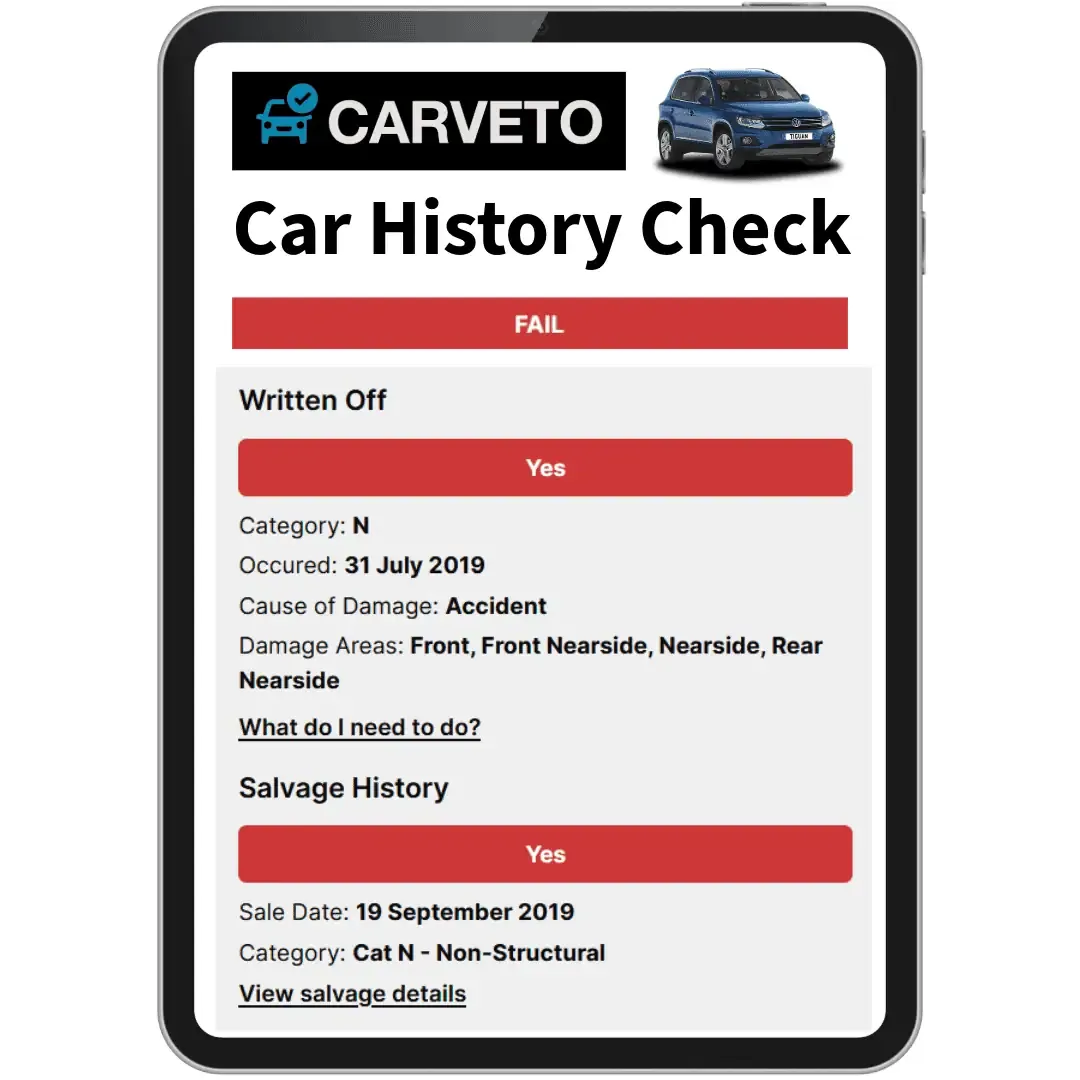
The report also includes full insurance write-off categories, showing whether the vehicle has previously been damaged and how severe that damage was.
Categories N and S indicate repairable issues, while A and B mean the vehicle should never return to the road.
Stolen markers from the Police National Computer (PNC), along with export markers, are also shown.
A stolen flag means the vehicle can be seized immediately.
Export conflicts, where a car is registered abroad but still advertised in the UK, are another high-risk red flag.
Together, these checks confirm whether the vehicle is legally safe to buy.
If a car has outstanding finance, can I safely buy it?
No, you cannot safely buy a car with outstanding finance unless the finance is fully settled and the lender confirms clear title.
Outstanding Finance Check Details
A finance check reveals the lender’s name, the type of agreement (such as PCP, HP, conditional sale or lease), the date it began and whether it is marked as settled.
This information helps you determine who legally owns the vehicle.
If the finance remains active, the car cannot be legally sold by a private seller, and purchasing it puts you at risk of losing both the vehicle and your money.
Even when the seller claims the finance is “about to be settled,” always verify this directly with the finance provider before proceeding.
A legitimate seller will have no issue confirming with an official settlement letter.
Write-Off Category Explanation
Insurance write-off categories indicate how severely a car was damaged and whether it is safe to return to the road.
• Cat N — Non-structural damage. Often cosmetic or electrical, but still requires proper repair.
• Cat S — Structural damage. Must undergo professional repair and be made roadworthy before use.
• Cat B — Severe structural damage. Vehicle must be broken for parts only; the shell must be crushed.
• Cat A — Total destruction. Nothing can be salvaged.
A vehicle listed as Cat N or Cat S can be bought and driven legally once repaired, but insurance, resale value and safety may all be affected.
You can learn more about these categories using the Car Write-Off Categories guide.
Stolen and Export Markers
Stolen markers come directly from Police National Computer records and indicate that the car has been reported as stolen by its rightful keeper or insurer.
A vehicle with any active stolen status should never be purchased.
Even if you bought it unknowingly, the police can seize it immediately without compensation.
Export markers show when a vehicle has been declared exported or registered abroad.
If the car is shown as exported but is physically being sold in the UK, this mismatch is a major red flag.
It may indicate cloning, identity manipulation or fraudulent registration activity.
Full Vehicle Specification and Technical Data
A free CarVeto report includes the vehicle’s full technical specification so you can verify the car matches its advert and confirm the details are accurate.
You’ll see engine size, BHP, torque output, fuel type, gearbox type, body style, kerb weight and overall performance profile.
These details come directly from DVLA and manufacturer-coded records, helping you check the car’s actual configuration before arranging a viewing.
Specification mismatches are common in used-car listings, often because sellers copy generic data, use template adverts or rely on incorrect third-party sources.
Our Car Spec Check tool shows the vehicle’s officially recorded technical specs so you can confirm whether the advertised features, such as engine power, trim level, or fuel efficiency, are genuine.
This section gives you a reliable baseline view of what the car should be, making it easier to spot misleading adverts, cloned plates or vehicles that don’t match their description.
Why might the spec shown online differ from the DVLA record?
Most spec differences happen because sellers use incorrect or generic data. When a car’s advertised specification doesn’t match the DVLA record, the mismatch is usually caused by template listings, estimation, or third-party data errors. Always trust the DVLA-CarVeto based specification for accuracy.
Engine and Performance Data
CarVeto reports include a vehicle’s key performance data, including engine displacement, power output (BHP), torque rating and drivetrain type.
These figures help you understand how the car will perform in real-world driving and whether it matches your expectations for fuel economy, acceleration and insurance group.
If the seller’s advert lists unusually high power or performance figures that don’t match the DVLA-recorded specification, this can indicate incorrect advertising or a modified vehicle.
Emission and Compliance Data
The report includes CO₂ emissions, Euro emissions standard and environmental classification, helping you understand the vehicle’s running costs and potential access restrictions.
These values also influence annual tax cost and whether the car is likely to be ULEZ or Clean Air Zone compliant.
For full tax-band rules and emissions-based rates, you can review our Car Tax Bands guide.
Legal Status Check: Tax, MOT and Insurance Indicators
A free CarVeto report brings together the key legal indicators that confirm whether a vehicle is safe and permitted to be driven on UK roads.
You’ll see the current tax class, tax expiry date and whether the vehicle has an active export or SORN declaration.
The MOT status shows when the next test is due and whether the car is currently roadworthy based on DVLA records.
The report also includes an insurance coverage check, giving you a quick signal of whether a policy appears active.
These checks help you confirm that the car is legal to drive and that the seller is presenting accurate information.
For full legal verification across tax, MOT and basic insurance indicators, you can use our Gov Car Check tool.
Does CarVeto show my full insurance policy details?
No, CarVeto does not show full insurance policy details. The report only displays an insurance indicator via askMID and insurers group rating (1 to 50) as complete policy information is held by insurers and cannot be shared publicly.
Vehicle Tax Status
Your free report displays the vehicle’s tax class, the exact date the current tax expires and whether the car has been declared SORN.
This snapshot helps you confirm whether the car is legally taxed and safe to drive.
Driving an untaxed vehicle can lead to fines, enforcement penalties and vehicle seizure, so it’s essential to verify the tax status before viewing or buying.
MOT and Insurance Indicators
This section shows the vehicle’s MOT expiry date and whether the car is currently recorded as having a valid MOT certificate.
It also includes an insurance-presence check, giving you a basic indication of whether a policy appears active.
For deeper confirmation of active cover, you can use our askMID Insurance Check service.
Compare Free and Full Vehicle History Checks
When you run a free CarVeto check, you see the essential DVLA and MOT data needed to confirm basic identity, mileage trends and road legality.
This is ideal for early research or when shortlisting multiple vehicles. A Full Car History Search goes much deeper.
It includes finance agreements, write-off categories, salvage history, police-stolen markers, plate change history, import/export status and multi-source mileage analysis that cross-checks DVLA, BVRLA and RMI records.
A full report is recommended for any car worth more than a few thousand pounds, or whenever something in the free data raises concern, such as mileage gaps, frequent keeper changes or inconsistent MOT patterns.
If you want a complete pre-purchase assessment, you can review our vehicle history guide for an overview of what a full car history check includes.
Do I really need a full car history check before buying a used car?
Yes, get a full car history check before buying a used car if you want to confirm finance status, write-off history, stolen markers and deeper mileage verification. A free check does not include these higher-risk data fields.
Comparison Table: Free vs Full Check
The comparison below shows exactly which data fields are included in your free CarVeto report and which require a Full Vehicle History Check.
This helps you quickly understand what level of verification you need based on the value of the car and the risk factors involved.
Data Field/Feature | Free Check | Full Vehicle History Check |
|---|---|---|
DVLA vehicle details (brand/model/body) | ✔ Included | ✔ Included |
Registration & tax status | ✔ Included | ✔ Included |
MOT status & expiry | ✔ Included | ✔ Included |
Full MOT history | ✔ Included | ✔ Included |
DVLA mileage records | ✔ Included | ✔ Included |
Multi-source mileage verification (DVLA+BVRLA+RMI) | ✖ Not included | ✔ Included |
Outstanding finance check | ✖ Not included | ✔ Included |
Insurance write-off categories (Cat A, B, S, N, plus legacy C & D) | ✖ Not included | ✔ Included |
Salvage auction records | ✖ Not included | ✔ Included |
Scrappage records | ✖ Not included | ✔ Included |
Police stolen markers (PNC) | ✖ Not included | ✔ Included |
Export/export marker | Export only | ✔ Included |
Plate change history | ✖ Basic signal only | ✔ Included |
Colour change history | ✖ Not included | ✔ Included |
VIN mismatch verification | ✖ Not included | ✔ Included |
Market valuation | ✖ Not included | ✔ Included |
Risk score & purchase guidance | ✖ Not included | ✔ Included |
Understanding what’s included at each level helps you decide when a free check is enough and when a full report is essential to avoid costly or unsafe purchases.
With that foundation in place, the next step is knowing how vehicle checks actively reduce buying risks and support better decisions.
Why Vehicle Checks Matter: Buying Safely and Reducing Risk
A vehicle history check helps you make confident decisions when buying a used car by revealing issues that may not appear in advert photos or descriptions.
The process is simple: you find a car you’re interested in, run a free history check, and instantly see whether the vehicle is taxed, MOT’d, accurately described and legally safe.
If the check highlights warning signs, such as inconsistent mileage, sudden keeper changes, write-off markers or missing MOT history, you can investigate further, renegotiate the price or walk away entirely.
History checks also protect you from common fraud risks, including cloned plates, outstanding finance, incorrect logbook data and inaccurate advertising.
These risks are harder to spot during a quick viewing but become clear once you compare the seller’s claims with official vehicle records.
For a clearer understanding of how history checks fit into the full buying journey, visit our Car Definition guide.
Do I really need to check a car’s history before viewing it?
Yes, always check a car’s history before viewing it. Running a CarVeto history check first helps you avoid wasted trips, identifies high-risk vehicles early and confirms whether the advert matches official records.
Physical Inspection Checklist Overview
A digital history check is essential, but it must be paired with a thorough physical inspection before buying.
Even if the report shows a clean record, worn tyres, corrosion, poor repairs or unusual driving behaviour can appear only when you view the car in person.
A structured checklist ensures you examine bodywork, tyres, suspension, brakes, fluid levels, electrical functions and interior condition.
A short test drive also helps reveal mechanical noises, steering issues or braking inconsistencies.
For a complete walkthrough of what to inspect during a viewing, use our Car Inspection Checklist.
Why Choose CarVeto: Trusted Data for 6.4M+ UK Drivers
CarVeto uses the same trusted data sources relied on across the UK motor industry, giving drivers a reliable and transparent view of a vehicle’s true history.
Each check pulls live records from DVLA vehicle databases, MOT test history, the Police National Computer (PNC) for stolen markers, and the industry-standard MIAFTR write-off register.
Full checks extend this further with Experian finance data, revealing outstanding HP or PCP agreements, and multi-source mileage verification through BVRLA, RMI and the National Mileage Register.
Our verification process is supported by real automotive expertise, combining technical knowledge, accurate data interpretation and a decade of experience producing UK vehicle reports for private buyers and dealers.
With more than 6.4 million checks completed, CarVeto is a trusted alternative to generic reg-lookup tools, giving motorists clearer, deeper and more dependable insights before they commit to a purchase.
Choosing CarVeto means choosing accuracy, transparency and a history check designed to keep UK drivers safe.
⭐ Rated 4.9/5
✔️ Secure, DVLA-approved vehicle data
✔️ Fast, private, and used nationwide
Recent Customer Reviews
Excellent service
Philip Rogers
⭐⭐⭐⭐⭐
Excellent service. Went above and beyond to resolve my query regarding missing MOT’s. Highly recommend this service to anyone changing vehicles.
Best money I spent
Garwin Lam
⭐⭐⭐⭐⭐
I was all ready to spend the money and time to buy a used private car, only to find the seller had not been truthful. I will happily recommend CarVeto.
Can't praise them enough
Zena Merton
⭐⭐⭐⭐⭐
It's not just the report they provide it's the fact that you can contact them about the issues raised. Emailing a human as opposed to no customer support or an AI chatbot.
FAQs About Car History Checks
Yes, the free car check is completely free. There is no subscription, no trial period and no hidden charges.
A paid Full History Check is optional if you want finance, write-off or stolen-vehicle data.
A free car check is a basic DVLA and MOT report showing tax status, MOT expiry, mileage readings and key vehicle details such as make, model, fuel type and registration date.
A free car check includes tax status, MOT status, DVLA-recorded mileage, plate history, a basic keeper indicator and the core technical details held in DVLA records.
You check MOT history by entering the registration number and viewing the MOT dates, results, advisories and mileage readings.
Check MOT History of a Vehicle to see full test records since first registration.
You can check car tax by entering the registration number into CarVeto and viewing the live DVLA tax class, expiry date, and any SORN declaration.
A full breakdown is available on our Car Tax Calculator page.
You check if a car is stolen by running a paid Full History Check, which includes active Police National Computer stolen markers.
You can learn more on our Stolen Car Check page.
You can see the number of previous keepers in a Full History Check, including the dates of each keeper change.
More details are available on our Car Owners Check page.
Yes, most Northern Ireland registrations are supported.
Enter the plate, and CarVeto will confirm whether DVLA datasets return full coverage.
The data is accurate because it comes directly from DVLA, MOT databases, the Police National Computer, MIAFTR and industry mileage sources such as BVRLA and RMI.
Accuracy depends on how quickly each provider updates its records.
No, CarVeto does not show policyholder details or insurer names.
It only indicates whether an active policy appears on the Motor Insurance Database.
See our Car Insurance Check page.
Yes, plate-change history appears in the Full History Check, showing all previous registration numbers and the dates they were applied.
More information is available on our Car Number Plate Check page.
Yes, a Full History Check reveals active finance agreements, including the lender and agreement type.
See our Outstanding Finance Check lookup.
Yes, write-off status, including Cat N, Cat S, Cat A and Cat B—is shown in the Full History Check.
Run an instant Car Write-Off Check now.
Yes, salvage and auction history may appear in a Full History Check where available.
You can learn more in our Salvage History Check.
Yes, Full History Checks show import and export markers, revealing whether a vehicle has been registered outside the UK.
More information is available on our Car Import Check page.
Mileage may be missing if past MOT tests were not logged properly or if DVLA data is still updating.
A Full History Check cross-checks BVRLA and RMI mileage records for extra clarity.
No, CarVeto does not store your registration number.
It’s used only to retrieve vehicle information and is fully GDPR-compliant.
A vehicle may not be found due to DVLA update delays, a recent private plate transfer, or a newly issued registration not yet in the public dataset.
Yes, you can run unlimited free car checks.
You only pay if you choose to buy a Full History Check for deeper information.
Are You Ready to Run Your Free Car Check?
Run a Free Car History Check now to see the vehicle’s tax status, MOT history, mileage and DVLA-recorded details in seconds.
There’s no signup and no hidden costs, just fast, trusted data pulled directly from official UK sources.
Enter any registration above to verify a car before you buy and make a safer, more confident decision.